
Ten Ways to Improve Clarity in Medical Writing
At Emtex Life Science, medical writers apply lean writing or lean authoring, which is a clear and concise writing style that eliminates all unnecessary elements for the audience and keeps the message to the point. When using a lean writing style, the text should still be complete to serve its purpose and audience and at the same time be easy to read and comprehend. Applying lean writing means to cut down on creative ‘showy’ language, write straightforward and precise, and provide the “so what”, not just restating results, and include answers to potential questions.
The ability to clearly communicate through writing is in high demand in any industry. Here are 10 ways to improve clarity in documents:
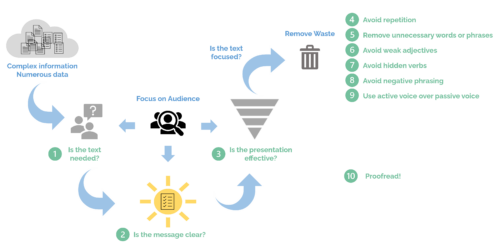
Focus on Your Audience
All writing has an intended audience, an ultimate purpose, and a structure. Therefore, it is important to focus on your audience and to ensure that what you write fulfils the reader’s needs.
- Is the text needed?
Carefully consider what your audience needs to know. Provide compelling arguments and an interpretation of the results, and ensure that there is a story, not just a storage of information or an information dumb. Writing for a general audience is not the same as writing for scientific audience. For example, for a general or non-expert audience, you may have to simplify complex concepts, avoid jargons, and use easy graphs to make the content more accessible.
- Is the message clear?
Pay attention to how you formulate and present your message and whether it is clear for your audience. Writing in clear and concise language increases readability and makes the content easy digestible. Tips to accomplish this include the use of bulleted lists, tables, and figures instead of text, where possible; mention one idea per paragraph and limit the number of sentences in the paragraph; highlight key phrases and words to draw the reader’s attention; and facilitate navigation. For instance, meaningful and informative (sub)headings help readers find the content they want/need, and links can provide easy access to more detailed information.
- Is the presentation effective?
The most effective way of presenting the information is by using top-down writing based on the inverted pyramid writing principle. The inverted pyramid is a writing model commonly used in journalism, but can be applied to many kinds of writing. The inverted pyramid style presents the information in descending order of importance. The most critical information including key facts and what may be considered the conclusion is provided first, followed by less important information, such as supporting details to understand the main ideas and by nice-to-have information such as background information. In contrast to the usual writing style, it ensures that the reader knows the key facts and conclusion after having read the first paragraph. In case the reader wants to know more, it can be found in the details that follow. This writing style improves comprehension, helps to structure the content more logically, and facilitates scanning the text to find specific information or skimming the text to get a general overview.
Remove Waste
To keep the text focused, all writing should be free of ‘waste’, and, therefore, you need to write, rewrite, and cut down. Remove or avoid the following elements that may distract the reader from the important information:
- Avoid repetition.
Take out duplicated words or phrases within sentences. Do not repeat the information that is already presented, unless necessary. It is better to place the information at the most logical place in the document and then refer to it using cross-references, but be careful to not overuse cross-references.
- Remove unnecessary words or phrases.
Ensure that all words deserve to be in the sentence. Challenge every word – do you need it? Is there a shorter alternative? If yes, then replace it. For instance, “due to the fact that” and “given the fact that” can be replaced with “because” or “since”. Look for unnecessary intensifiers such as “very”, “much”, and “quite”; for vague nouns such as area, field, and degree; and for empty fillers such as in other words, as a matter of fact, and as such. Try to recognize and avoid tautologies; like past history, 2 pm in the afternoon, and short summary.
- Avoid weak adjectives.
Weak adjectives do not stand on their own because they are ‘gradable’ and are used with ‘modifiers’ such as very, extremely, and quite. Swab weak adjectives for strong, descriptive adjectives to shorten your sentences.
- Avoid hidden verbs.
A hidden verb or nominalization is a verb converted into a noun. Look for endings such as –tion, -sion, and –ment. It often needs an extra verb to make sense so it is better to put the action in the verb. For example, convert the sentence “They gave us information” to “They informed us”.
- Avoid negative phrasing.
Negative phrasing requires extra words and is harder to understand. Try to use positive language whenever possible. Do not use double negatives or exceptions to exceptions as these are even harder to understand. Look for negatives and change them to affirmatives.
- Use Active Voice Over Passive Voice.
To improve clarity in writing, use the active voice over the passive voice as passive sentences tend to be wordier and have two basic features, although both may not appear in every passive sentence. It takes a form of the verb “to be,” such as “are,” “was,” “were,” “could be,” or “have been” and a past participle. Keep most of your sentences in active voice which makes your writing more direct and engaging. However, note that in scientific writing, the passive voice can be useful to remove the emphasis on the subject.
- Proofread
Once a document is finished, proofread the content thoroughly to ensure that no inconsistencies or errors in grammar, spelling, abbreviations, and formatting are present.
Conclusion
In conclusion, identify and focus on your audience to understand what is really needed from their point of view, choose words wisely, construct sentences and paragraphs carefully, and present the data in the most effective way. Everything that is not needed should be eliminated and try to cut down as much as possible. Medical writers at Emtex Life Science implement the above elements in their documents and thereby, develop clear, concise, and well-structured documents that ensure to grab and hold the audience’s attention. Please refer to our Emtex Academy training on lean writing for more details and examples.